Revolution V4 — November Development Update
Since our 30 October development log, Revolution V4 has grown in several directions at once: new ways to build your character, more reasons to explore, encounters that ask you to learn their patterns, and a much clearer client to bring it all together.
This update covers the work completed in the V4 development build from 31 October to 6 November. There is a lot to explore below, from Grave Knight and Spell Mastery to the rebuilt World Boss system, Hunting Contracts, equipment crafting and the new EMBER Store.
These notes cover V4's development build. Screenshots use sample character data; balance values remain subject to playtesting. Use the full-size links beneath the images for a closer look.
A New Path: Grave Knight
Grave Knight joins Revolution V4 as a new melee specialisation with its own resources, a gravebound companion in combat and a dedicated region of the Passive Tree. Land your own attacks, build resources and decide when to spend them.
- Runes: three independently regenerating resources fuel your runeblade attacks.
- Dread: successful qualifying melee hits build a second resource for finishers, defensive choices and recovery. Hitting a whole group does not multiply the same cast's resource award.
- The Sentinel: one summoned fighter supports the enemy you are actively engaging. It stays engaged as long as you keep fighting.
- Three Ascendancy directions: Ebon Marshal develops your Sentinel partnership, Rime Reaver rewards Cold combinations, and Blood Warden supports a more durable melee playstyle.
- Fight while moving: supported pulse sequences follow your current position, while targeted follow-ups still need their original enemy to remain in valid range.
The class becomes available through its class entrance at level 100. Its normal Passive Tree support and Ascendancy choices work alongside the existing eight-point Ascendancy limit. You decide when to spend Dread, engage your Sentinel or recover.
Class Signatures and More Spells to Grow Into
The class entrances now give their level-100 signature spells a more recognisable identity. The change is tied to allocating the class entrance, rather than simply having the vocation. Some signatures split an attack into a short sequence, some share part of a hit with nearby enemies, and others reshape where the attack lands.
- Elementalist: Prismatic Shard gives Frost Shard a mixed elemental identity.
- Battlemage: Runic Echo follows Arcane Slash with a delayed Energy impact.
- Ranger: Splinter Volley shares part of Piercing Arrow with additional wild monsters.
- Trickster: Ricochet Knife gives Backstab a returning or bouncing follow-up.
- Gladiator: Shield Shock turns Shield Slam into an impact followed by a shared frontal shock.
- Berserker: Savage Flurry gives Savage Blow a short melee sequence.
- Juggernaut: Rolling Shockwave adds a forward aftershock to Ground Pound.
- Mystic: Totemic Relay lets Spirit Bolt interact with a suitable owned totem.
- Necromancer: Haunting Bolt gives Corpse Bolt a sequence of soul pulses.
- Grave Knight: Reaping Sweep reshapes Rune Cleave into a forward arc.
These changes redistribute the spell's existing attack budget. Three pulses do not mean three full-strength casts. Positioning, armour, elemental defences and the normal rules for follow-up hits still matter.
We have also adapted selected spells from the older archive into current class kits, with new requirements, behaviour and balance. Examples include:
- Exile - Rock Storm, level 70: another Physical option before specialisation.
- Battlemage - Chain Blast, level 225: an Energy attack with controlled secondary targeting.
- Elementalist - Deep Freeze, level 325: a Cold spell rebuilt for the current combat rules.
- Ranger - Arrow Dance, level 225: several arrow waves around a committed target area.
- Trickster - Ring of Blades, level 225: a blade orbit that rewards deliberate placement.
- Gladiator - Ancestral Warchief, level 275: a directional sequence with distinct frontal and flank sweeps.
- Berserker - Great Cut, level 375: an opening strike and a finishing blow that responds to the target's remaining Life.
- Juggernaut - Massive Quake, level 225: separate inner and outer shockwaves.
- Mystic - Fountain of Life, level 275: a committed sequence of self-healing pulses.
- Necromancer - Seeking Pillars, level 325: delayed Death strikes on marked locations.
- Grave Knight - Death Star, level 425: a forward Death attack with a returning strike.
Gladiator has also received Duelist Edge at level 110, Crescent Sweep at 160, Steel Reprise at 225 and Champion Tempest at 450. They fill different roles for single targets, directional pressure and fighting groups. Check the Spellbook and your in-game spell menu for current requirements and descriptions.
Spell Mastery: Develop the Abilities You Actually Use
Supported spells now have their own Mastery progression and individual talent trees. This gives a favourite ability room to develop without forcing every spell in a class to follow the same upgrade template.
- Progress through 100 Mastery levels, earning one talent point every five levels, up to 20 points for that spell.
- Choose between three themed branches, with a single major specialisation choice rather than collecting every major effect.
- Earn progress through meaningful combat effects, useful recovery and eligible support. Empty casts and overhealing do not provide a shortcut.
- Read how each talent changes the selected ability. Some improve efficiency or damage, while others add a limited follow-up, alter an element or create a different tactical role.
- Reset an ability's talents for gold while keeping its earned Mastery XP and levels. Other spells keep their own choices.
Mastery belongs to the individual spell. Its extra impacts and recovery effects have limited budgets; they do not produce unlimited chains of additional attacks or free healing. Learning and changing talents requires a safe moment outside combat in a Protection Zone.
The website now has a Spell Mastery reference where you can browse by class and ability before deciding which direction to take.
Equipment Crafting: More Build Choices, Clearer Decisions
The equipment system has received a large expansion: 35 additional normal enchants and 30 additional corruptions, bringing the current pools to 118 normal enchants and 42 corruptions. The additions cover more of Revolution's different playstyles, rather than concentrating every useful roll around the same few stats.
- Minion builds: new options support non-Totem minion damage, Life and duration, with separate choices for corpse-related play.
- Melee and ranged builds: new attack-oriented rolls, close-range support, conversion choices and limited secondary-hit effects.
- Elemental casters: more spell, penetration and elemental specialisation options, with tradeoffs on the stronger conversions.
- Mystic: Totem Life, duration, casting and defensive support, alongside choices that ask for a higher Mana commitment.
- Recovery and defence: more ways to support a durable character without making every defensive roll interchangeable.
Affixes have equipment-slot restrictions and item-level requirements. A high-tier result is something to build towards; a new enchant does not automatically belong on every piece of equipment. Equipment defence progression has also been reviewed so armour, evasion and Energy Shield provide clearer alternatives across different gear families.
The Upgrader has been rebuilt as The Forge, with a shared workpiece across its five tabs, clearer operation descriptions and a visible materials strip. You can choose a target upgrade level and use automatic attempts with the required catalyst protection. The flow stops when it reaches the goal or cannot continue with the available resources.
The materials at the bottom now have their own tooltips, so you can identify the currency before spending it. Our Upgrade System guide explains the currencies, enchant tiers, upgrade risks and corruption choices in more detail. Read the operation before committing an item.
Hunting Contracts: A Longer, More Consistent Task Journey
The Task system has become Hunting Contracts, with a redesigned board and a reward model built around steady progression. All 144 contracts remain part of the catalogue, but their rewards now follow a common set of rules.
The board lets you search creatures and contracts, browse recommendations, save favourites and separate active or ready-to-claim hunts. Choose a contract size that suits your session and see the reward information alongside your progress.
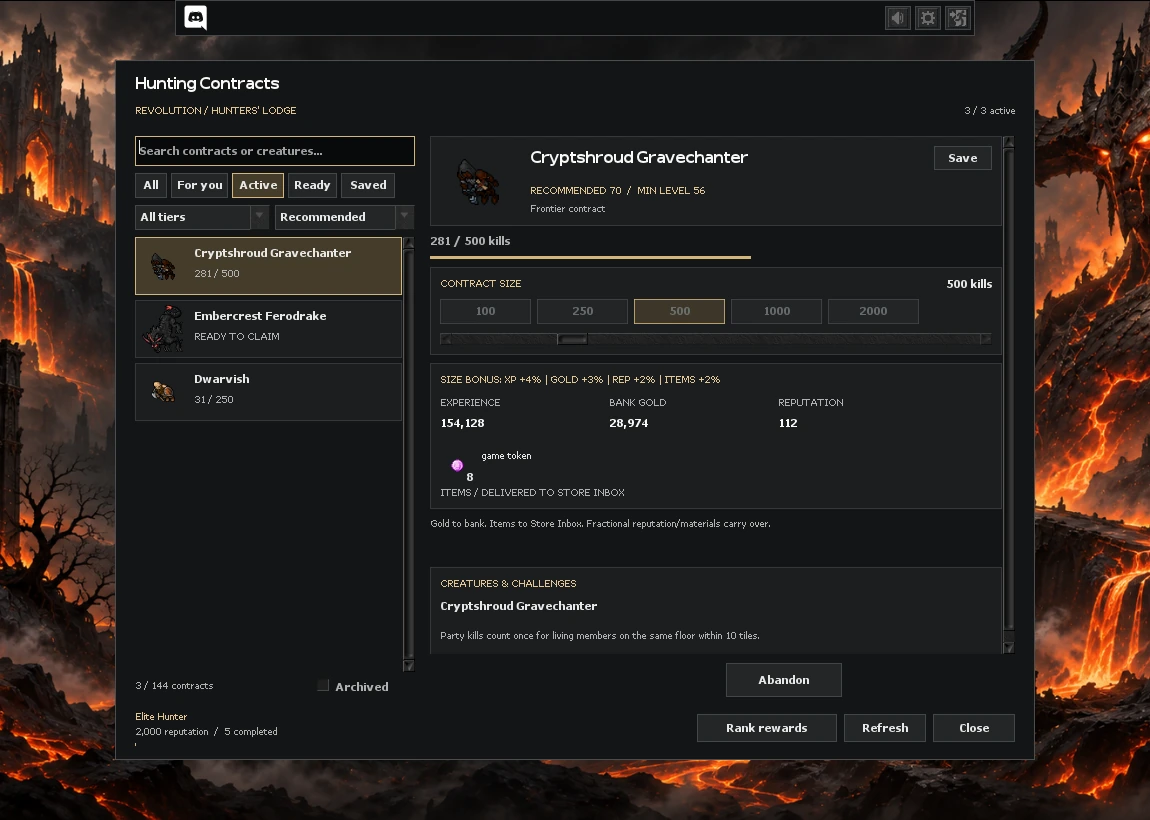
The new contract board keeps the hunt, its progress and its rewards in one place.
- Rewards follow what you kill. Mixed monster families account for the actual creatures defeated, so hunting the weakest member does not pay as though every kill was the strongest variant.
- Larger contracts receive measured bonuses. A 500-kill contract currently adds 4% task XP, 3% gold and 2% reputation/materials. At 2,000 kills the bonuses are 19%, 14.25% and 9.5% respectively.
- Shorter hunts remain worthwhile. Reputation and material fractions carry between claims, rather than disappearing through rounding.
- Overlapping contracts are controlled. You cannot activate new contracts that duplicate the same monster progress, and party credit is handled consistently.
- Claiming is clearer. Gold goes to your bank and item rewards go to your Store Inbox.
The rank ladder now has 19 ranks. Huntmaster sits at 40,000 reputation, followed by Elder, Mythic and Legendary Huntmaster, with Eternal Huntmaster at 140,000. Previously earned ranks are preserved through the conversion, and contracts already in progress keep their original reward terms.
There are also eight rank milestones to claim as you progress. Rewards include Hunter and Demon Hunter outfit addons, War Bear and Crystal Wolf mounts, the Squirrel companion, Prismatic Wings and Golden Glow Wings. These are character-earned progression rewards, separate from account-wide Store purchases. Open Rank rewards on the contract board to check your milestones.
Dungeons: Progression That Fits the Rest of V4
All 18 dungeons have been reviewed together, from the Tomb of Manamully at level 50 to Twilight Geode at level 1,200. Entry level, required item level, costs, time limits and reward progression have been brought into a more consistent relationship.
Dungeon selection should now give a clearer sense of what belongs next in your character's journey. Early expeditions introduce the system; later ones demand stronger equipment, better preparation and more reliable execution. Party-size scaling remains part of the challenge, alongside the selected difficulty.
The bosses have also received individual encounter identities. Manamully feels like the ruler of an ancient tomb, Glacious brings winter into the room, Balark's forge becomes part of the confrontation, and the later encounters ask more of both personal awareness and the group.
- Early dungeons: readable movement challenges and simpler encounter structures.
- From around level 200: more involved phases, objectives and combinations begin to appear.
- Later progression: longer encounters can include personal responsibilities, changing battlefield conditions and more demanding sequences.
- Warnings matter: floor markings, countdowns and encounter instructions give you information before the important decisions.
We want discovery to remain part of the experience. This article will not list exact health triggers, safe tiles or the sequence that solves a boss.
Higher Difficulty Now Changes the Fight
Normal, Hard, Expert, Master, Torment and Hell are no longer distinguished only by larger numbers. Across the 18 dungeon bosses, 54 new boss-specific attack variants have been added to the difficulty progression.
- Normal establishes the boss's core encounter.
- Hard and Expert broaden its attack repertoire and introduce more of its identity.
- Master begins combining attacks and adds further encounter pressure to the more advanced bosses.
- Torment expands the available patterns and objective demands.
- Hell uses the most demanding combinations and further late-fight tests.
The early dungeons keep a gentler learning curve even on higher modes. They gain variety and movement pressure without receiving the same added immunity phases, puzzles or execution mechanics as the advanced encounters. Moving into tougher content should feel like learning a richer fight, not suddenly meeting every endgame mechanic at once.
A Dungeon Archive on the Website
Open Explore > Dungeons to browse the full Dungeon Archive. Every expedition now has a dedicated page with its atmosphere, boss identity, entry requirements, party size, time limit, costs and possible personal rewards.
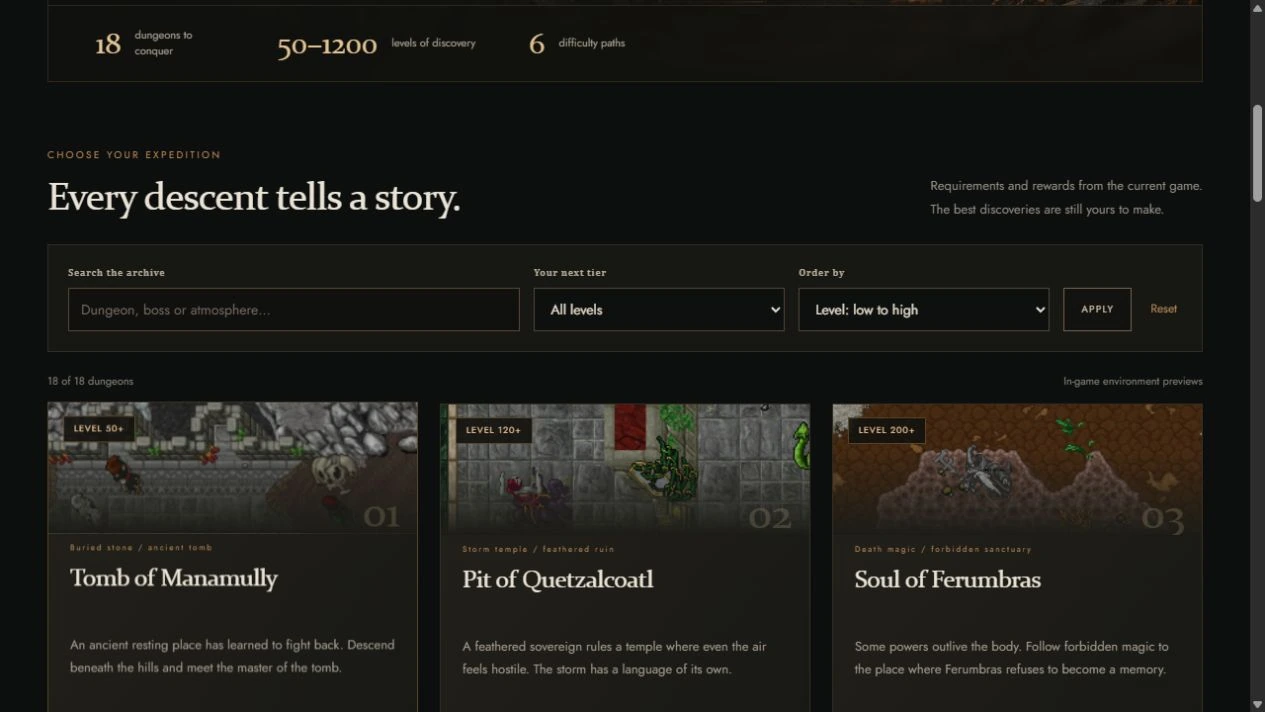
- Search by dungeon, boss or atmosphere, filter by level range and change the sort order.
- Compare all six difficulty paths and their eligible reward chances.
- Search an expedition's possible rewards before choosing where to hunt.
- Hover an item to see its base in-game stats, or select its name to keep the details open. The same information is accessible on mobile.
- Read a field guide that introduces the encounter without handing you its solution.
The reward tooltips distinguish the base item from its listed final drop item level. Random enchants, upgrades and item-level scaling are not presented as guaranteed base stats. Higher-mode loot percentages use the game's rounded personal-roll rules.
World Bosses: Events Worth Gathering For
Azmodan and Innocence have moved to a dedicated World Boss Event system, replacing their old raid flow. Events use announcements, temporary temple entrances, encounter stages, return portals and personal reward handling as parts of one event.
- Azmodan and Innocence retain an approximately daily schedule, with staggered events rather than every boss appearing together.
- Azmodan's route now correctly requires both Geminae and Geminus before the passage opens.
- Qualifying contributors receive their own reward rolls. Owning a pet or summon does not make its contribution belong to somebody else.
- Return access and event cleanup are handled consistently, including when an encounter ends or its time expires.
- Rewards awaiting delivery can be retried through the collection interface.
Open Main Menu > World Bosses for your Boss Collection Log. It records personal kills, your best recorded event clear, delivered rewards and the drops you have yet to discover. A collection entry is a record of what you actually received, not just a list of what could have dropped.
Ten New World Boss Encounters
The roster now includes ten additional bosses across recommended levels 100–1,000. These are different encounters with their own identities, rather than the same room recoloured ten times.
- Rhazek - level 100: a directional arrow trial built around reading where the next volley comes from.
- Mirelith - level 150: a drowned domain where rising water and breath change the rhythm of the fight.
- Nerubis - level 200: a living web of silk, trapped space and encounter objectives.
- The Ashen Mirror - level 300: reflected positions and shifting geometry turn your movement into part of the threat.
- Caldraz - level 400: a furnace encounter with dangerous ground and a survival sequence that asks more than damage.
- Crimson Vicar - level 500: a blood-alchemy encounter with volatile materials and group responsibilities.
- Saelyra the Unblinking - level 600: a gaze-led fight that makes awareness and facing matter.
- Ironwake - level 750: a siege encounter with artillery pressure and shared battlefield duties.
- Vaelith - level 900: unstable distance, temporary rifts and a battlefield that refuses to stay familiar.
- The Unmaker - level 1,000: a late-game encounter built around persistent danger and a shrinking margin for error.
Some phases temporarily stop ordinary damage and ask the group to handle the encounter itself. The most dangerous threats are announced, but an announcement is not a promise that standing still will be survivable. The recommended levels introduce the intended progression; they are not a guarantee that one character of that level will defeat the boss alone.
Monsters With More Presence
Regular hunting has received attention alongside the headline bosses. The monster modifier pool now contains 59 modifiers, including 40 additions, creating more variation within the existing rarity system.
Expect combinations with clearer identities: defensive monsters, elemental follow-ups, pressure that builds while a creature stays on the same target, and effects that reward changing how you approach the fight. Stronger mechanics are restricted to the appropriate rarity and compatible creature types.
This expansion does not simply make every monster Rare or give every creature more modifiers. Read the names and descriptions on the boss bar and use the Monster Modifiers guide to understand the effects you encounter.
Selected monster spell kits have also been rebuilt with more individual behaviour, while repeated attacks and bouncing spells have received targeting and timing fixes. The aim is for a creature to feel dangerous for a reason you can recognise.
Active Fishing and the Angler's Journal
Fishing is now an activity in the world, rather than a menu that catches fish for you. Carry a rod and bait, cast onto visible water, watch for the bite and follow the moving splash with the same rod.
- The catalogue contains 69 species, including 64 additional fish, across different fishing-skill requirements and habitats.
- River, open water, shallows, cold water and caves give you reasons to try different places. Eligible lava fishing also has its own requirements.
- Supported rods offer different progression options; the water and your equipment both matter.
- The Angler's Journal records catches, discoveries, perfect catches and your best recorded fish sizes per character.
- Fishing is performed with the rod in the world. Closing the journal does not cancel an active line.
Fish also have a practical use after the catch. The expanded species support food effects with limited durations, and only one fish meal buff can be active at a time. You can refresh a fish buff even when ordinary nutrition is full, without stacking a second meal on top of the first.
Open Main Menu > Fishing, use !fishing, or press Ctrl+Shift+J for the journal. The Fishing guide explains the current rods, fish, waters, requirements and food effects.
Divination Cards: More Sets, More Reasons to Keep Hunting
We have added 24 new Divination Cards alongside the original 18, with new artwork, crafting-material rewards and rarer sets for collectors and traders.
Many of the new sets provide useful crafting resources: embers, upgrade catalysts, identification supplies and the different orbs used to develop equipment. Others offer a defined equipment reward rather than an unlimited source of endgame power.
Five of the additions are deliberate chase cards: The Final Temper, The Dragon Hoard, The Astral Crown, The Last Reflection and The Eternal Flame. Their rewards include rare crafting resources and carefully defined equipment goals. They are intended to be long-term finds that make a drop memorable and give player trading something worth searching for.
Check each card's set size, source and reward information. A rare card is not a promise that a short farming session will finish its set, and collecting the art is only one part of deciding which reward you want to pursue.
The EMBER Store
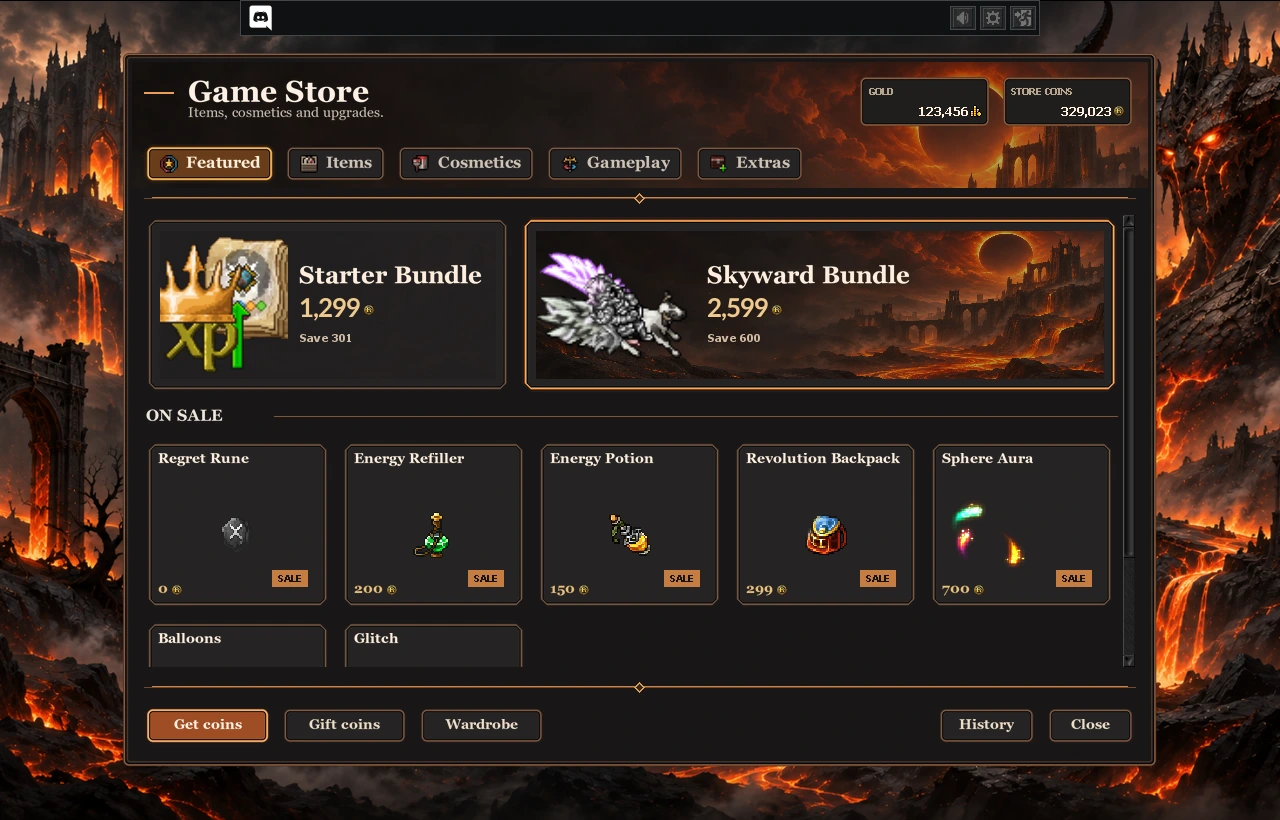
The Game Store has received a complete visual rebuild in the EMBER style: charcoal surfaces, copper framing, rounded outer corners, a volcanic backdrop and clearer separation between offers, prices and actions.
Bundles have room to show what makes them different, product artwork sits naturally on the cards, and the category tabs, purchase confirmations and supporting windows now belong to the same visual design. The layout has also received a pass for smaller client windows.
- Browse Featured, Items, Cosmetics, Gameplay and Extras through aligned category controls.
- Use search, price ordering and relevant ownership or affordability filters.
- Watch supported outfit, mount, wing and aura previews animate instead of relying on a single still frame.
- See the original and replacement beside each other when browsing spell skins.
- Use the correct Store coin balance for Store coin purchases. The balances and purchase feedback have been corrected.
Coin gifting remains available. Existing purchases, ownership information and confirmation steps are part of the same Store experience; the redesign is meant to make the choice clearer before you spend.
Account-Wide Store Cosmetics
Eligible Store-purchased cosmetics now belong to the account, including supported previous purchases. You should not need to buy the same eligible cosmetic again simply because you created another character on that account.
This covers the supported Store categories such as outfits and their addons, mounts, wings, auras, shaders and spell skins. Each character can still choose its own equipped appearance and per-spell selection.
The distinction matters: Store ownership is shared; quest, drop and rank-earned rewards retain their own progression rules. Account-wide cosmetics do not turn a character-earned unlock into a Store purchase or transfer it to unrelated accounts.
Spell Skins: Choose the Spell, Then Choose Its Look
Spell skins are individual cosmetics for specific spells. The current collection contains 66 skins across 46 spells, with choices covering all 11 classes, including Exile and Grave Knight.
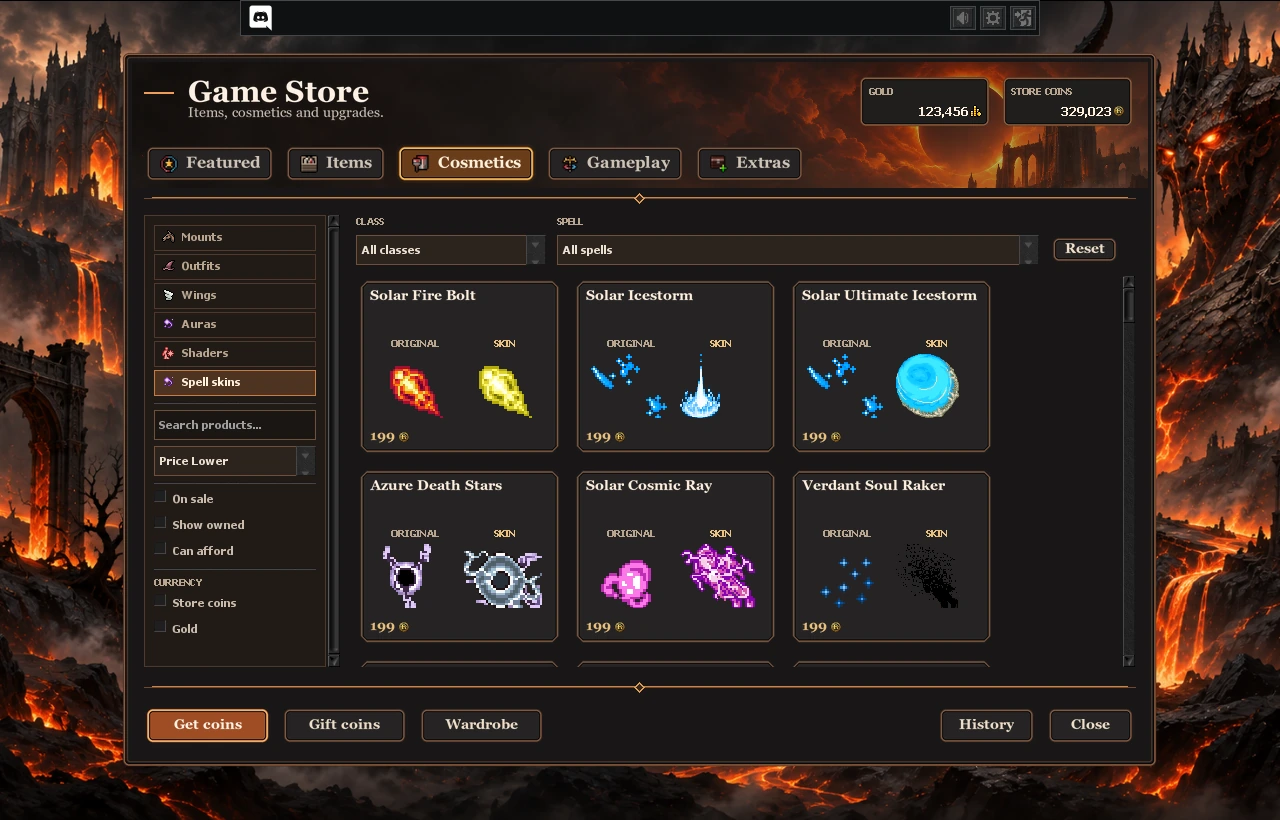
Find the correct class and spell, then compare the original animation with its replacement.
- Filter by class and spell in the Store to find the relevant offers.
- Use the class filter in Wardrobe to find your collection more quickly.
- Save a separate appearance for each supported spell and each character.
- Other players see the selected effect when your character casts the spell.
- Damage, element, hit area, resource costs and cooldowns remain those of the actual spell.
A skin changes the specified effects or missiles; it does not apply a general shader to all your spells. Companion shaders have also been isolated from spell previews, so changing a companion's style no longer colours unrelated systems.
Wardrobe: Equipment Looks and Companion Style
Equipment Looks lets you learn the appearances of compatible equipped items without consuming the equipment. Learned appearances become part of your account collection, while the selected item's original identity and combat stats remain intact.
- Learning is free. Use Learn Equipped Looks to add eligible appearances you have not already collected.
- Applying a different compatible appearance costs five Store coins. The displayed cost uses the same donation balance as the Store.
- Restoring the original look is free. Reapplying an appearance already active does not charge again.
- Looks must be compatible with the equipment slot and weapon family. Transmog changes the item sprite, not the outfit worn by your character.
The collection now gives clearer feedback when an appearance was already learned or no compatible equipment is available. Your actual equipment keeps its stats, upgrades and identity underneath the appearance.
Companion Style gives your follower a different visual presence using supported shaders you already own. Its original movement and idle animations remain, and the style adds no combat or collection advantage.
Character Profile and Inspect, Together
Character Profile and Inspect have been brought into one view. Give your adventurer a frame, a motto and a story, then let other players see the character behind the equipment.
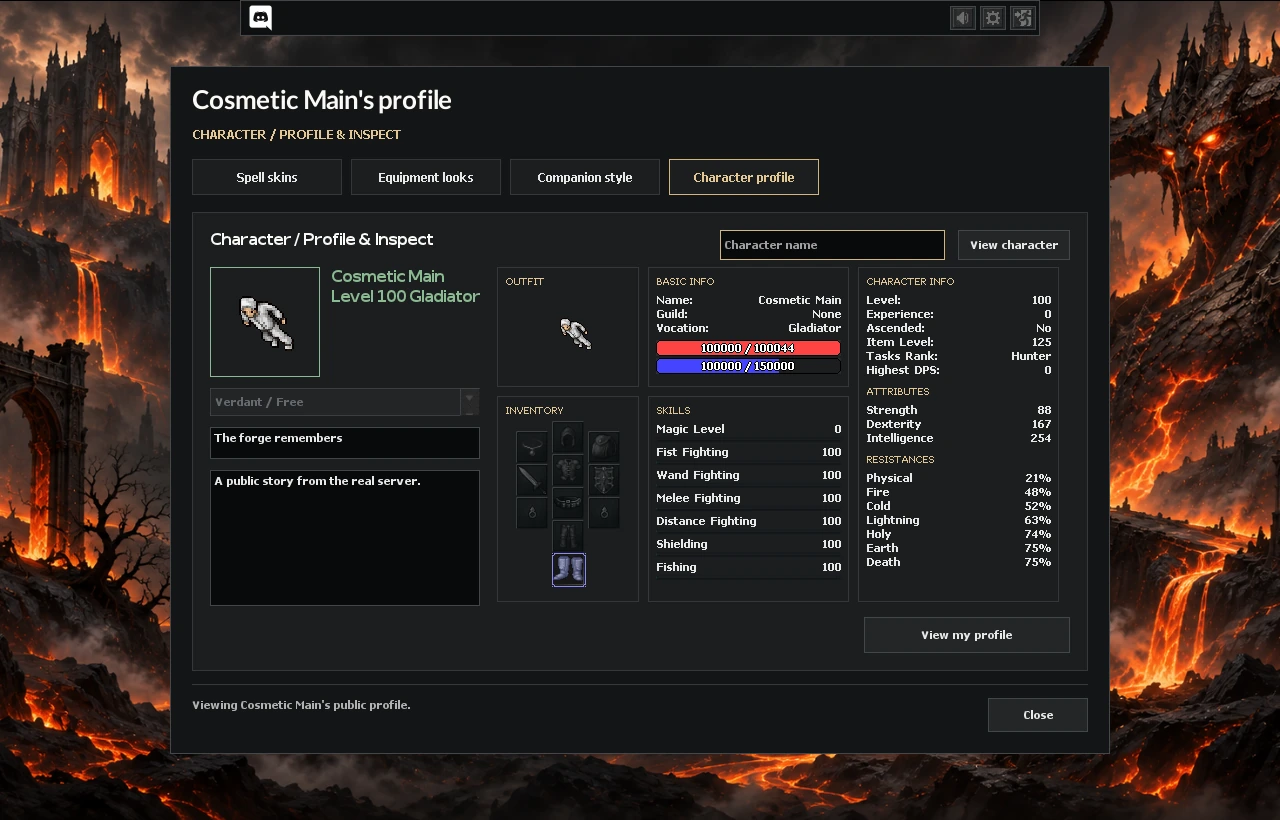
- View the character's outfit, equipment, basic information, skills and progression together.
- See Strength, Dexterity and Intelligence, including the inspected character's bonuses.
- See effective Physical, Fire, Cold, Lightning, Holy, Earth and Death resistances.
- Hover equipment for its item tooltip, including supported upgrade information.
- Search for another character or open a profile through the existing Inspect/profile access.
The layout has received an alignment pass, and switching between players now updates the information for the selected character. Profile text and a cosmetic frame do not alter combat stats.
A Smaller Main Menu and More Useful Everyday Windows
The Main Menu is now a compact, searchable list with alphabetic ordering and more distinctive icons. It gives the growing number of systems a useful home without turning the menu into a wall of oversized buttons.
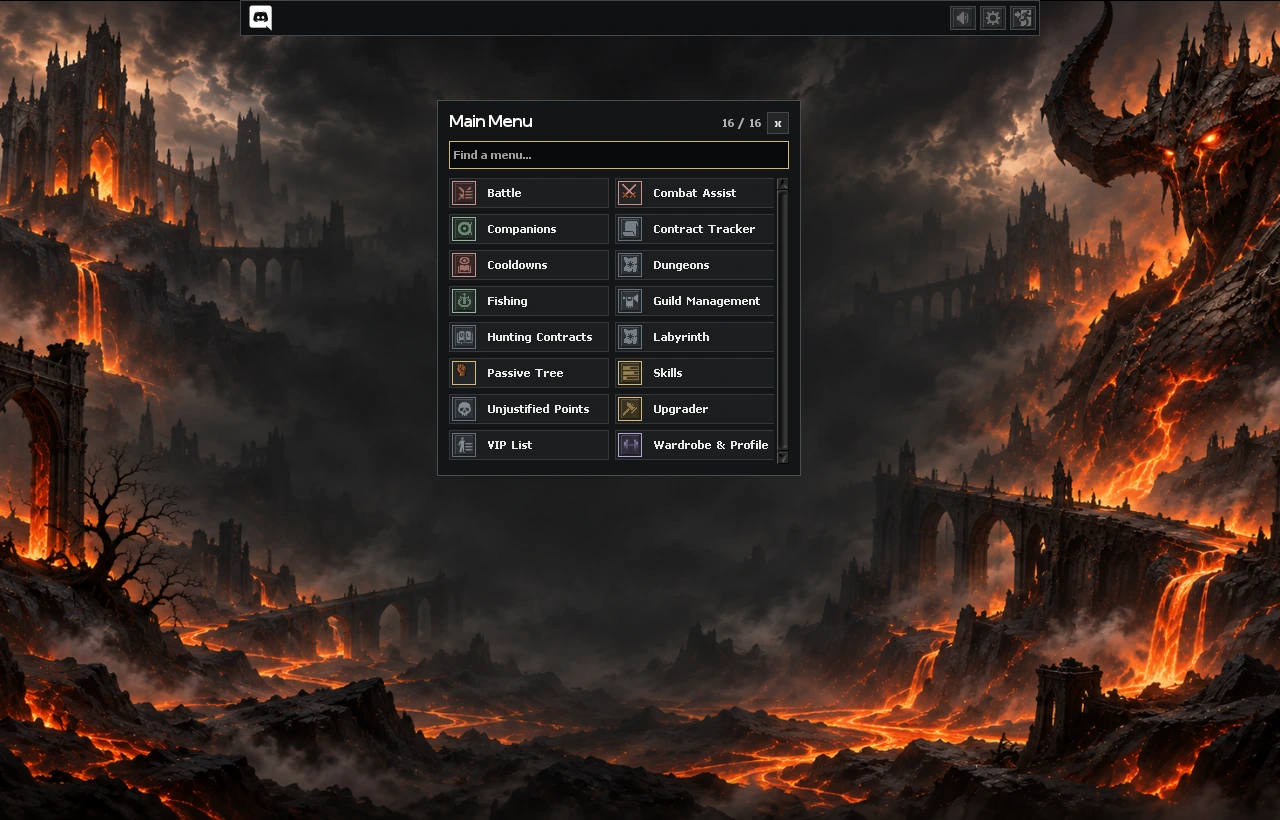
The client has received a wider consistency pass across menus, inventory-related windows and stash interactions. Search, quantity selection, tooltips and smaller-window layouts have been reviewed so everyday actions need less wrestling with the interface.
- Skills: stats are grouped into clearer sections, all existing values and tooltips remain available, and the window can be stretched further down to show more at once.
- Options: interface colour themes have live previews. The darker Charcoal layout is the default; Daylight has been toned down and contrast improved.
- Character selection: a cleaner layout, a new apocalypse-themed background and a redesigned character creator.
- Character creation: the connection problem that made Create appear unresponsive has been addressed, with clearer failure feedback.
- Updater: Check for Updates now asks you to log out first if your character is still in the game, including when the character list is open over gameplay.
NPC Trading and a Better Equipment Market
NPC Trade has been rebuilt around finding an offer, inspecting the selected item and choosing the amount. Buy and Sell remain familiar, but the new layout makes the information easier to use.
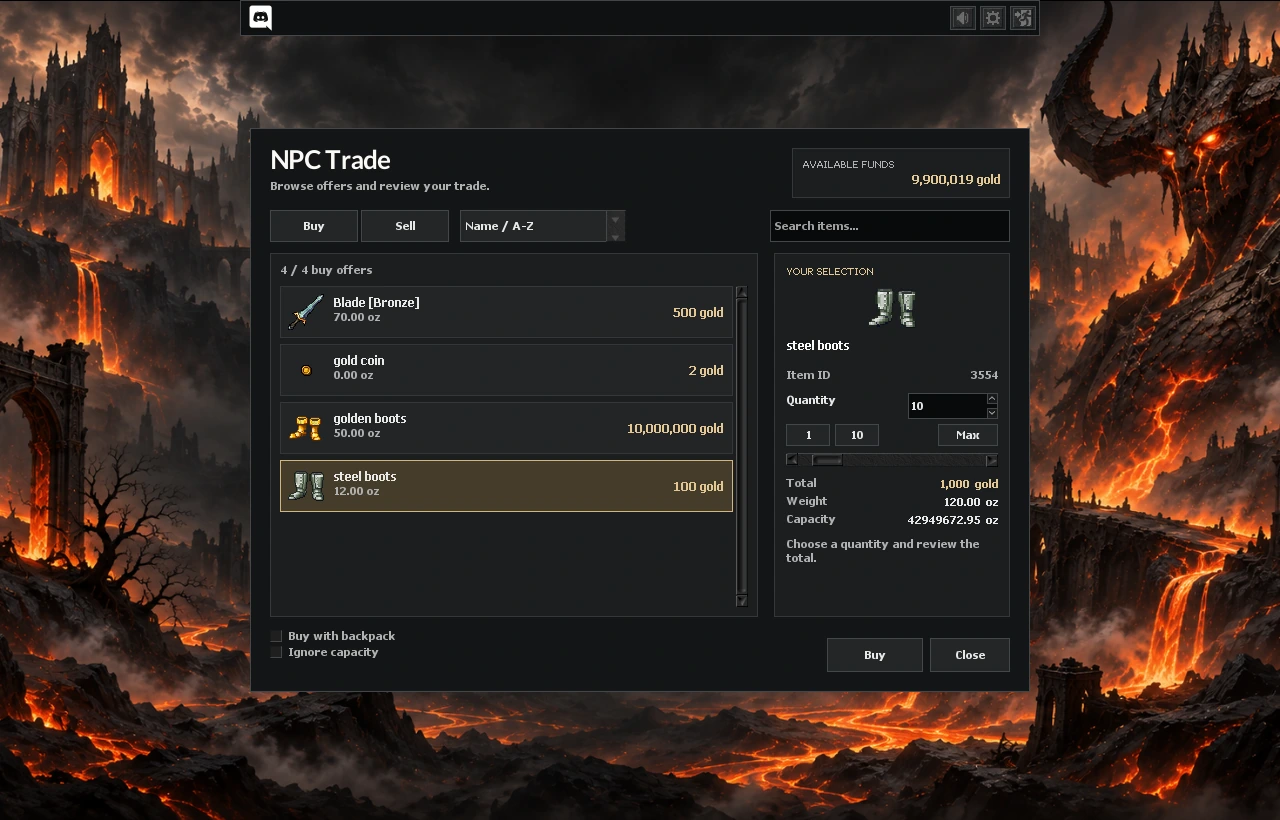
- Search and sort the available offers instead of scrolling an unsorted grid.
- Review the selected item's price, total cost, weight and available capacity.
- Type a quantity or use the quick quantity controls.
- Keep the existing backpack and selling options, with clearer totals before confirming.
The Depot Market now supports real equipment listings with their own stats and enchants. Instead of searching only for an item name or broad category, you can combine enchant filters to find the type of item your build needs.
You can list eligible equipment directly from your backpack, depot or inbox. Worn equipment must first be moved into a supported container. Details, Statistics and My Offers have received fixes so browsing an item and finding your own listings are useful parts of the market again.
Purchasing a particular enchanted item is meant to deliver that exact item, with its properties preserved. The market's stat filters, ownership views and listing information make that distinction clearer.
Know Whether Your Backpack Is Protected
The equipment header now has a protection indicator with a detailed tooltip. Hover it to see which regular blessings are active or missing, whether an equipped Amulet of Loss is providing protection, and whether your backpack is currently protected.
- An equipped Amulet of Loss or all five regular blessings protects backpack and equipment under the normal protection rules.
- Twist of Fate is shown separately. It is not a substitute for a missing regular blessing.
- Red and black skulls override loot protection. The indicator warns about this explicitly; AoL and blessings do not remove those skull consequences.
- The display updates when relevant equipment, blessings or skull status changes.
The underlying death handling has also received fixes so a protected death follows the protection state instead of accidentally entering the ordinary random-drop flow. The tooltip is there to let you check your actual situation before leaving safety.
A More Stable Adventure
A broad review of active spells, creature scripts and repeated events has addressed cases that could interrupt the server or leave an effect running after it should have ended.
Multi-strike and delayed spells now handle the caster dying, logging out or losing a valid target more carefully. Bouncing attacks have clearer target selection, monster attack timing conflicts have been corrected, and event cleanup has received particular attention. These changes support the more involved encounters without turning every extra effect into a risk to the session.
Repeated work in dungeon menus, companion updates, XP handling and loot/stash lookups has also been reduced. The player-facing goal is simple: smoother menus, less unnecessary work during busy moments and fewer interruptions while hunting with other people.
Valuable equipment now has persistent item identity to help investigate duplicate items and protect the economy. Legitimate trading and moving equipment between supported systems should preserve the item you own.
Player Guides and Clearer Fair-Play Rules
The website now provides more useful references for planning a build and choosing your next activity. Browse Classes, the Spellbook, the Passive Tree planner, Spell Mastery, Upgrades, Fishing, Monster Modifiers and the new Dungeon Archive.
The Rules and Policy have also been rewritten for clarity. The built-in Combat Assister remains the permitted gameplay automation tool. External bots, macros and other unauthorised automation, along with deliberate exploitation or duplication, carry whole-account deletion on a confirmed first offence. Donations do not provide an exception.
The disciplinary appeal window is 72 hours from the written enforcement notice, with private contact available through [email protected] or the official Discord. An appeal received in time pauses final deletion while staff review it. Please read the full Rules rather than relying on this short summary.
What Comes Next
This is a substantial development step, but the point of the new systems is how they play together: earn equipment through hunts and encounters, develop it into a build, shape individual abilities and keep finding a worthwhile next goal.
Labyrinth remains work in progress. Its routes and completion setup are still being prepared, so this update does not announce it as a finished playable release.
For the new content, the next priority is continued playtesting across different levels, classes, equipment and group sizes. Tell us which dungeon or boss you tried, its difficulty, your party size and what felt unclear or out of line. For a spell or build issue, include the ability, character level and relevant setup.
Thank you for helping shape Revolution V4. There is more to discover, more to collect and a lot more room to make a character your own.